Welcome to my blog series about my passion to the movies and television. I hope you enjoy what I have to say when I express my opinions and you are free to have your own thoughts.
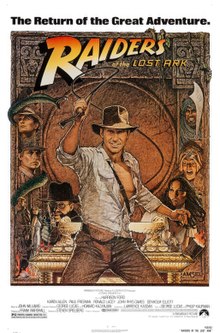
In the summer of 1981, Raiders of the Lost Ark arrived in theaters. With a budget of $20 million, it grossed $389 million. Critics and audiences alike embraced the film for it's action, sense of humor, it's unique take on classic serials, and Harrison Ford's iconic performance as Indiana Jones. Roger Ebert called the movie an "out of body experience, a movie of glorious imagination and breakneck speed that grabs you through a series of incredible adventures, and deposits you back in reality two hours later-breathless, dizzy, wrung-out, and with a silly grin on your face." It has spawned 3 sequels, video games, merchandise, and stunt shows at the Disney theme parks. Raiders of the Lost Ark has since been considered one of the best movies ever made, but it had a tough time getting on the screen.
Origins, Inspiration, and Development
George Lucas conceived Raiders of the Lost Ark in 1973, shortly after completing American Graffiti. Lucas, as we all know, grew up with classic serials on TV, such as Flash Gordon and Buck Rogers, and studied subjects such as anthropology, literature, and sociology in college. He conceived an archeologist named Indiana Smith, named after his dog (Indiana Jones and the Last Crusade even made an in joke about this at the end of that movie). He temporarily put Indiana Smith on hold to work on Star Wars, which had become the most successful film ever made at that time.
Meanwhile, Lucas discussed the idea to his friend Phillip Kaufmann (pictured here) and Kauffmann suggested the idea of the Ark of the Covenant. The Ark of the Covent of course is where the supposed fragments of the actual Ten Commandments are hidden, which would provide the conflict between Indiana Smith and the Nazis. Lucas wanted Kauffman to direct, but he was already committed to the Clint Eastwood vehicle, The Outlaw Josey Wales.
After Star Wars have come out, Lucas and his friend Steven Spielberg were vacationing in Hawaii. Spielberg expressed his desire to direct a James Bond movie, but Lucas thought something better. He explained the Indiana Smith concept and Spielberg loved the idea. However, he didn't like the name Smith and suggested Jones. Lucas agreed with the name change.
Lucas now had to find a studio that is willing to fund the project for an estimated budget of $20 million. Every studio in Hollywood have turned it down, not only because of the budget, but also because Spielberg's previous films had fallen behind schedule and over budget. It also didn't help that Spielberg's 1979 comedy, 1941, was a critical and commercial disappointment. Thankfully, Paramount had green lit the project with the help of Michael Eisner (who would later revive Disney in 1984).
Having been impressed by the screenplay of the romantic comedy Continental Divide, Spielberg hired Lawrence Kasdan to write the screenplay for Raiders of the Lost Ark. Spielberg, Lucas, and Kasdan spent 3 days sketching out the plot and set pieces, and Kasdan would insert their ideas in the screenplay. Impressed with the wit and humor to the story, Lucas would later hire Kasdan to do The Empire Strikes Back.
The Casting of Indiana Jones
Lucas was initially reluctant to cast Harrison Ford, because, referring to Martin Scorsese, he didn't want Ford to be his Robert De Niro and cast him in everything he does. He wanted fresh talent such as Tim Matheson, Jeff Bridges, John Shea, and Tom Sellick (pictured on top). Sellick almost got the role, and he auditioned alongside Sean Young (who was considered for the role of Indy's girlfriend, Marion Ravenwood). But Sellick turned it down, because he was contractually obligated to do Magnum P.I. for CBS. Having seen Sellick in other films like Three Men and a Baby, In and Out, and An Innocent Man, it gives me insight that Sellick would be the wrong choice for Indiana Jones.
Spielberg was impressed with Harrison Ford's performance in The Empire Strikes Back, and convinced Lucas to cast him. Ford agreed to the part, and it became one of Ford's most iconic roles in his career.
Filming and Special Effects
Principal photography commenced in June 1980 and concluded in September. With an estimated $20 million budget at hand, Spielberg did everything he could to stay on time and on budget. To date, this is the most storyboarded film of his career, with approximately 6,000 storyboard drawings from artists such as Michael Lloyd, and Joe Johnston. Spielberg also relied on pre-viz miniatures to set up and plan the action sequences carefully before they started shooting.
Filming took place in England for Elstree Studios, Hawaii for the opening sequence, and Tunisia was used to depict Egypt. To keep production costs down, Spielberg hired British talent, including cinematographer Douglas Slocombe, production designer Norman Reynolds, stuntman Vic Armstrong, and associate producer Robert Watts.
The shoot was a learning experience for Spielberg, as he managed to film the movie on schedule. However, that doesn't really mean that the shoot was free from problems. Filming in Tunisia was unbearable, since it was very hot and the crew got sick from food poisoning, although Spielberg remained healthy by eating canned goods.
After the success of the Star Wars films, Industrial Light & Magic became one of Hollywood's most reliable special effects companies. Under the supervision from Richard Edlund, and made during the pre digital age, ILM employed techniques such as miniatures, stop motion, blue screen, rotoscoped animation, cloud tanks, and matte paintings.
The film's climax is a masterstroke in special effects, but it also caused trouble with the MPAA. Because there was a shot of a head blowing up, the MPAA threatened the film for an R rating. Because Spielberg aimed for a PG rated film that audiences of all ages would see, a flame effect was added to conceal the violence, so the R rating was prevented, thankfully.
Raiders of the Lost Ark is ILM's first non-Star Wars project, as well as Spielberg's first collaboration with ILM, and they have been creating special effects since.
Music and Sound Design
John Williams has given us memorable film scores over the years, and Raiders proves that Williams' past contributions were no flukes. His intention was to create music that was theatrical and excessive. To establish Indy's heroic adventures, Williams created two separated pieces of music for Spielberg, who thankfully used both, and that's how we got the iconic "Raiders March".
Sound designer Ben Burrt was hired to create unique sound effects for Raiders of the Lost Ark, very much like he did for his groundbreaking work on Star Wars. The sounds of the snakes protecting the Ark was achieved by Burrt recording sounds of his fingers running through cheese and mixing it with sounds of a wet sponge dragged across a grid tape. The iconic sound of the rolling boulder that opens the film is actually a Honda Civic driving down gravel hill. The sound of Indy's pistol is a Winchester rifle and the sound of the punches and kicks were the sounds of baseball gloves.
Legacy and Lasting Impact
Raiders of the Lost Ark finally opened in June 1981 after a somewhat rocky development process and has since become one of the most iconic movies ever made. After the successes of Jaws, Star Wars, Close Encounters, and Superman, Raiders of the Lost Ark sent a signal to Hollywood that the big budget blockbusters are hear to stay.
Stay tuned for part 2, in which I will explain why Raiders of the Lost Ark is the kind of movie that Disney should have been making back in the 70s and early 80s.
In the 1977 holiday season, Walt Disney Productions released the live action/animated musical extravaganza, Pete's Dragon. It was expected to "win back the crowd" by becoming a Mary Poppins-sized blockbuster, but it backfired drastically and it was panned by most critics. 45 years later, many Disney fans have since expressed their disappointment with the movie. After Walt Disney's death in 1966, the studio's popularity was loosing its steam, as the company became creatively stagnant by playing it safe for family audiences. That's why many moviegoers turned to a new generation of filmmakers such as Stanley Kubrick, Robert Altman, Martin Scorsese, Francis Ford Coppola, George Lucas, and Steven Spielberg. The movie also arrived when the rise of the summer blockbusters was at its peak, starting off with Jaws and Star Wars, and continuing with Close Encounters, Superman, Alien, Indiana Jones, and ET. The big budget blockbusters were in, and Disney was in a slump at the time.
Origins and Development
The movie was based on an unpublished short story written by Seton I. Miller and S. S. Field. Walt Disney optioned the rights in the late 1950's, with the intention of turning it into a two-part episode on the Disneyland TV show. But plans were scrapped, leading the project into development hell. In 1975, producer Jerome Courtland rediscovered the project, hired Malcolm Marmorstein to write the screenplay, and revamped the project into a musical. British filmmaker Don Chaffey (Jason and the Argonauts) was hired to direct the film, mainly because of his past experiences with Disney.
Special Effects
Much like Song of the South, Mary Poppins, and later with Who Framed Roger Rabbit, Pete's Dragon combined live action with animation. The dragon was designed by long time veteran Ken Anderson and animated by Don Bluth and his team (it's one of the last projects Bluth did before he left Disney in 1979). A process similar to today's blue/greenscreen processes were used to help combine the live action and animation. The animation of the dragon and the live action footage were filmed separately, then they use an optical printer to give the audience the illusion that this poor kid really was interacting with that dragon. I'm not a fan of the design of the dragon. He looked a bit too cutesy for me with his green skin, large stomach, and inexplicably pink hair. The live action/animation mix is okay, but it's really nowhere as convincing as it later will be with Who Framed Roger Rabbit 11 years later.
My Thoughts on the 2016 Remake
Before we get to my thoughts on the original film, I think it's best to discuss the remake first, because I actually liked this film better than the original. I watched this film with very low expectations because I don't like Disney live action remakes and I didn't like the original film. So watching this new version is actually a surprise. Watching this film actually reminded me on what Siskel and Ebert used to say about remakes. They often say "don't remake masterpieces, remake flawed films", and I think director David Lowrey succeeded on that level, even though it's not a perfect film. I felt that it was a much more rounded story than the original film and I felt that it has a much more interesting dragon. I'll go into more detail in a stand alone review in the future.
My Honest Thoughts and Conclusion
I think the reason why many people have forgotten about this film 45 years after this film have come out is that it has a very weak story, it barely has memorable songs, and the dragon itself is such a crushing bore. The movie never establishes how Pete discovered the dragon, where the dragon came from, and how they became friends. Instead, it throws you straight into the film with no real build up, as they escape from Pete's abusive adoptive family. When they arrive a small town named Passamaquoddy, the film turns into predictable slapstick territory until Pete finally gets adopted by a woman who lives at the town lighthouse with her father, while two quacks make desperate attempts to kill the dragon to sell their crappy medicine. So far, we have an overstuffed script, with several plot threads just lazily slapped on each other. The film also spares no expense providing cheap slapstick that has been recycled from past Disney comedies.
The film has been discussed a lot by Disney aficionados online, and most expressed their frustrations and disappointment with the movie. But to be honest, there are some things I liked about it. British stage actor Jim Dale and comedian Red Buttons were highlights to me as the quacks. Their two songs when they arrived in town to con potential patients and their desire to kill the dragon for profit were the best songs in the movie in my opinion. And Mickey Rooney, who plays the owner of the town lighthouse, does the best with what he is given. They made the movie more bearable to watch. The location shooting of the lighthouse totally tricked me, because it looked like it was filmed in the East Coast, but it was filmed in California. You got to give them credit for that. The real downside to the visual components, apart from the design of the dragon, is the setting of Passamaquoddy. Given the fact that it was shot in a studio, it really looked like a theme park attraction at the Disney Parks rather than a real town that could exist in the early 20th century.
The whole thing about the dragon speaking gibberish is really flawed from the get go, and it gets irritating for a while. Whoever came up with the idea for the dragon's language needs a good slap in the face. As for the overstuffed climax, director Don Chaffey clearly can't shoot action. When the dragon gets trapped by the town fishermen so the quacks can kill him, everything looks very average and old fashioned. It's very standard stuff. And the movie ends with a sappy and corny conclusion that the dragon has to share his goodbye to Pete, so he can help another kid.
Overall, Pete's Dragon is not a good movie. It came out in a time when the movies were changing (especially with the release of Star Wars and Close Encounters) and Disney was in a slump at the time. So it's a film that nobody wanted to see in the first place, and seemed very much like a quick cash grab to capitalize on any remaining Disney fans. It's a shame that the Disney empire played it safe in the 1970s. The studio made a fatal mistake to keep making the same kinds of movies after Walt's death, which is really silly because Walt loved to innovate and explore new ideas. I understand that they were struggling without him, but there's really no need to keep things the same. There are some enjoyable scenes in the film, but these moments don't come from the dragon. The quacks are far more interesting to watch. What else could I add? Despite the 2016 remake correcting its mistakes, it's a highly forgettable movie that really shouldn't have been made.
In March 30th, 1990, The Teenage Mutant Ninja Turtles leaped way onto the big screen. With the popularity of the comics, cartoon, and toys at hand, expectations from the fans were very high and it exceeded them, grossing $135 million. Despite it's financial success and high praise from fans of the franchise and fans of 80's/90's cinema, most critics gave the film generally negative reviews. They wrote it off as this juvenile, overly dark and violent movie for kids, and felt that The Turtles were unappealing. Watching Siskel and Ebert's reaction to the film, they were even dumbfounded that the movie did so well.
I think the critics really misunderstood the film. Not only did they ignored the film's qualities, but the film itself has a lot in common with Richard Donner's cinematic interpretation of Superman from 1978, which was ironically praised by critics 12 years earlier. Let's address the qualities of both movies one by one and analyze what both movies have in common.
Groundbreaking Aesthetics
The first thing about the 2 movies that comes to mind is the groundbreaking aesthetics and special effects. Obviously, both movies have different technological advancements in making Superman fly and the Ninja Turtles come to life, but what they both have in common is that the effects share some believability.
Let's begin with the effects of Superman and how they convinced audiences to believe that a man can fly. Hollywood has made adaptations of comic books before in the forms of film serials or TV shows. But a big budget Superman movie was a huge risk back in the late 70's, and they needed a lot of money and new technology for the effects to pay off.
The film employs both old and new techniques. The effects include miniatures, matte paintings, and optical effects. But the most groundbreaking effect comes from an upgraded front projection process called the Zoptic process, which was invented by effects wizard Zoran Perisic. As explained in the above making of documentary, Zoran achieved this effects by synchronizing zoon lenses in both the projector and the camera to creative the illusion of Superman flying towards the camera. The best special effect however, is Christopher Reeve himself. Whenever he's on wires, or shot against blue or front projection screens, he shows some commitment, believability, and joy when the Man of Steel takes flight. The iconic final shot when Reeve smiles at the camera when flying in space really shows how much fun he has with the role.
12 years after Richard Donner made the audience believe that Superman can fly, director Steve Barron and Jim Henson's Creature Shop wanted to achieve similar goals of having the audience accept that crime fighting turtles can exist in New York City. The result was to create animatronics that are so realistic and believable, you totally forget that these are actors in suits. The turtle costumes don't look like plastic or foam latex at all. They look like flesh and blood. And even the facial animation look more expressive and more mechanical. Pardon me if I sound a bit conservative, but this is the kind of approach that the newer live action films should be using, because CGI often dates more than miniatures and optical effects. With the 1990 film, they didn't need computer animation, both because the technology was in its infancy at the time, and also because they knew that the animatronics wouldn't date the movie. It actually makes the movie timeless and more realistic in its visuals.
On a sad note, it would be the last project Jim Henson has worked on, as he sadly passed away 2 months after the film's release.
How Did Directors Richard Donner and Steve Barron Bring Realism To Both Movies?
When Richard Donner was approached to direct Superman, one of his key goals was to bring some verisimilitude to the material. Rather than playing it safe, he gives the audience impression that although this is a fictional universe, it really needed to be a believable world. Steve Barron, who actually was a crew member on Superman, clearly wanted to share the same goal Donner did, but both directors achieve it in radically different ways.
To start off with Superman, Donner focuses on Superman's journey as a hero in 3 distinct styles. The first act focuses on Krypton and it's eventual destruction, as baby Kal-El travels to Earth in the early 1950's. The second act establishes Clark Kent's realization that he's from the planet Krypton and it was his duty to save mankind. And the third act has Superman fully realizing his potential as a hero. The 3 acts are basically 3 different movies in one. First, it begins as a science fiction film, then it continues as a 50's teen film with its warm and inviting atmosphere, then it ends as a serious, yet adventurous, human interest story about what it takes to be a hero, with some occasional moments of comedy. Donner takes Joseph Campbell's analysis of The Hero's Journey and wraps it up with a balanced tone, so it has all of the ingredients audiences would want from a Superman film.
Another contributing factor about the movie's success is Christopher Reeve's great performance as both Superman and Clark Kent. It's well known that there was a talent search, with A-list stars and athletes being considered for the role of Superman. But when Donner set his sights on Christopher Reeve, who was a Broadway actor, he knew he found his Superman and he was. Reeve really makes you believe that he's the character, and takes him very seriously. If Reeve wasn't cast, then the movie would have fallen apart.
Superman laid the groundwork for comic book movies over the past 40 years, but there are moments where they lost their staying power, because by the mid to late 80's, many comic book movies have either flopped or fell below expectations, especially the notorious Superman IV back in 1987. So making a live action Teenage Mutant Ninja Turtles movie was a huge risk, as their main goal was to focus on the Kevin Eastman and Peter Laird comics rather than the cartoon (though some elements of the cartoon were kept, such as the colored bandanas). But if you add the surprising success of Tim Burton's Batman in 1989 and the popularity of the cartoon, expectations from the fans were obviously high and the move exceeded them in a similar way that Superman did 12 years earlier.
The main difference is that Superman's qualities were well addressed on the spot by the critics back in 1978, they completely ignored what TMNT had to offer, and wrote it off with surface level critiques of it's violence. What the critics really didn't understand is that underneath the so-called "mindless" fight sequences, this is really a moral film about family. The film establishes the relationship between the Turtles and their mentor, Splinter as a strong family unit, especially the bonding moments between Splinter and Raphael, the angriest of the Turtles. Once Splinter is kidnapped by The Foot Clan, headed by a criminal mastermind called The Shredder, they are totally heartbroken and are desperate to find him. And when Splinter makes spiritual contact to the leader of the Turtles, Leonardo, they band together at a campfire to speak with him spiritually.
Meanwhile, The Shredder has been exploiting teenagers by brainwashing them into thinking that the outside world rejects them, so they can join The Foot Clan and do crimes for him, such as robbing and stealing. One of the kids is the son of the news station April O'Neil, a friend of the Turtles, works for, and he joins The Foot because he thinks he father never cared for him. But when he bonds with Splinter, especially when Splinter explains his backstory, the kid learns the errors of of his ways and agrees to help Splinter and convince the other kids that The Shredder lied to them. To add further of The Shredder's exploitative goals, they actually remind me of when Pinocchio was tricked into going to Pleasure Island, because his lair also has an amusement center that has arcade machines, a skateboarding ramp, and a pool hall. So the film really has a serious core that was sorely lacking in the sequels, which were made both with desperate attempts to pander to kids and to capitalize on the franchise. There's real heart to both movies, making what you see on screen look and feel believable as possible.
Conclusion
Overall, both movies were made with similar goals from directors Richard Donner and Steve Barron. It's been over 30 years since the release of TMNT, and I'm happy that's it's being vindicated. It met the expectations of the fans and it made money, but the film's qualities have been tarnished by surface level critiques regarding its violence and tone, and is easily dismissed. Superman The Movie is a great superhero movie, TMNT 1990 is an underrated movie.
WARNING: The following review may contain spoilers. Watch the movie before reading the review.
Hello and welcome to part 2 of my Who Framed Roger Rabbit retrospective. Last time I covered the film's production, now I talk about the film itself to help demonstrate how the movie saved Disney.
Who Framed Roger Rabbit came out when audiences had little faith in animated films. I think part of the reasons why is that the bad taste of Disney's 1985 film The Black Cauldron was still present. That film had a very troubled history and left audiences cold. Disney was actually considering shutting down the animation division at the time, but once The Great Mouse Detective fared well with film critics and Don Bluth's An American Tail made so much money, executives Michael Eisner and Jefferey Katzenberg had finally become convinced that animation can still be a lucrative business.
So Disney took huge risks for Roger Rabbit by giving director Robert Zemeckis creative freedom and pouring so much money on the project. Once the film finally came out, critics and audiences were given a dazzling, funny, and imaginative film that treats the Golden Age of Animation and classic crime films with respect.
The film's nostalgia for classic cartoons was even apparent at the beginning of the movie because it actually opens with a fully animated sequence that is reminiscent of these old animated shorts from the past. It makes sense to open the film this way because cartoons used to be shown before the main feature. Once the animated sequence ends, the film starts to focus on Eddie Valiant (Bob Hoskins), a cartoon hating private investigator who reluctantly helps Roger Rabbit, an animated rabbit who gets framed for murder. As Eddie gets deeper into the case, he realizes that a corrupt city official (Christopher Lloyd) has plans to destroy the animated world of Toontown and has framed Roger for his crimes.
One of the film's biggest strengths is its tone. It mixes slapstick humor, crime drama, and suspense to make this film appealing more for older audiences than for kids. If the tone is imbalanced, then the film would have fallen apart. So it was really difficult to mix these genres together and they pulled it off. It's funny without pulling cheap laughs, and it's a very smart, suspenseful crime drama.
There had been live action/animated films before, such as Song of the South and Mary Poppins. But Who Framed Roger Rabbit was done so convincingly, you totally buy that these cartoon characters really inhabit the real world and vice versa. The animated characters can cast shadows, touch human objects, and the human characters convincingly interact with the animated characters. Looking at this film now, it holds up extremely well, but nobody would ever make a movie like this ever again, because Hollywood has been taking advantage of digital technology since the 1990's.
The cast all do a great job, but the best performance is from Bob Hoskins. Reportedly, he wasn't the first choice for Eddie Valiant. A lot of A list actors such as Harrison Ford and Eddie Murphy were considered before they chose Hoskins. I think they made the right decision to cast Hoskins, because you can totally buy his development from a toon hating detective haunted by the death of his brother to saving Toontown from being destroyed. I think this is the best performance of his career and I think it's a shame that his career didn't really take off after Roger Rabbit.
Director Robert Zemeckis and writers Jeffrey Price and Peter S. Seaman have clear visions that carried thorough the film. It doesn't feel like it was designed by a committee and it's clearly a love letter to classic animation. Disney has made the right decision to give Zemeckis creative freedom, because he was clearly on a roll. When Back To The Future was in production, Hollywood was skeptical of that movie. But when it came out, he proved them wrong and it became one of the most successful films in Hollywood history. So Who Framed Roger Rabbit further cemented his legacy as a filmmaker.
With it's smart and funny script, great performances, and it's high-quality combination of live action and animation, it has all the ingredients to make a solid, entertaining blockbuster. And that's how Who Framed Roger Rabbit saved Disney.
In the summer of 1988, Who Framed Roger Rabbit arrived in theaters. The film was a huge success at the box office, grossing $238 million worldwide. Critics praised the film for it's convincing combination of live action and animation, humor, performances (especially from Bob Hoskins and Christopher Lloyd), and it's ability to appeal more to adults than for kids. Along with An American Tail and The Land Before Time, it brought a renewed interest in feature length animated films for a wide audience, which is why we have so many animated films over the past 30 years, especially The Disney Renaissance.
Disney's Dark Days and Roger Rabbit's Development
To add some context, we have to go back to the 1970's and early 1980's. After Walt's death in 1966, the company was really struggling both creatively and financially. Sure, Walt Disney World opened in Florida in 1971 with great success, but it's the movies that were struggling. In an era where younger and ambitious filmmakers were making films they would like to make with little to no studio interference, Disney was largely identified as a family friendly brand that was stuck in the past. Most of the company's cinematic output in the 70's were juvenile live action comedies and divisive animated works like The Aristocats and Robin Hood. By the end of the decade and the beginning of the 80's, studio executive Ron Miller, who is Walt's son in law, wanted to do something different to the company.
In 1981, Gary K. Wolf's mystery novel, Who Censored Roger Rabbit? was published. Shortly after the book's publication, Disney acquired the film rights, giving studio executives the chance to produce a potential blockbuster.
In 1983, animator Daniel Van Critters has made test footage with comedian Paul Reubens as the voice of Roger Rabbit to convince Disney to green light the project. Unfortunately, the film was nearly cancelled until Paramount executive Michael Eisner replaced Ron Miller as the head of the company in 1984. With the project revamped in 1985, Robert Zemeckis was hired to direct the film based on his successes with Back to the Future and Romancing the Stone and Steven Spielberg was hired to produce the film through his production company, Amblin Entertainment. Screenwriters Jeffrey Price and Peter S Seaman were hired to write the script and the late Canadian animator Richard Williams, known for his long-awaited passion project, The Thief and The Cobbler, took on duties as the film's animation supervisor. Spielberg convinced other film studios to unite nearly all of their animated characters into one movie from Disney, which is a very risky thing to do.
How Did They Do That (Budget, Shooting, and Visual Effects)
Principal photography began in late 1986 at Elstree Studios in London, with additional months spent in Los Angeles and in Industrial Light and Magic for blue screen shots. To convincingly place animated characters in live action settings, the live action was done first. Live props were either manipulated by wires or mechanical devices to create the illusion that the animated characters were touching real objects. Rubber dolls based off the animated characters were used to help aid the actors where to look so they can convincingly interact with cartoon characters that would later be added in post production. To get into character, Charles Fleischer, who did the voice of Roger Rabbit, wore a Roger Rabbit costume on the set, probably so it would appear that the actors were literally hearing a cartoon rabbit talking to them in the same scene.
Because CGI and digital compositing was at it's infancy in the 80's, no computers were used during the making of this film. The animators were given large black and white stills of the live action scenes so they can draw the characters on top of them. They later shot test footage so their work would be approved. Once after rough animation was done, it was progressed on the traditional methods of inking and painting on cels and the cels were later shot with no background. The animated footage is later transferred to Industrial Light and Magic so it would be combined by an optical printer. To give the illusion that the animated characters were affected by live action lighting, 3 layers (shadows, tone mattes, and highlights) were animated separately and were later optically combined.
For scenes set in the animated world of Toontown, actor Bob Hoskins was shot against a blue screen at Industrial Light and Magic. Both the live action shots and animation were filmed separately and later composited.
Perhaps the biggest challenge the creative team ever faced was the film's budget. Because of the huge creative risks taken with this film, production costs was increasing so rapidly that Michael Eisner was really considering to shut production down. But his then-colleague and future DreamWorks co-founder Jefferey Katzenberg talked him out of it, possibly due to his confidence that Robert Zemeckis and Steven Spielberg would ever pull this off. Of course, if production was shut down, then the film would never have been made and a new era for animation would not occur.
Release and Reaction
In 1984, Disney created Touchstone Pictures so the company would release more mature fare. So when Who Framed Roger Rabbit was in production, Disney was concerned about the film's racy nature and Zemeckis refused to make alterations, since he was given creative freedom. So Disney decided to release the film on their Touchstone Pictures label and the MPAA gave the film a PG rating.
In the blockbuster filled summer of 1988, the movie finally got released in theaters and became a critical and commercial hit, ushering a new audience and a new era for animated films for over 30 years. Roger Ebert called the film a breakthrough in craftmanship as well as great entertainment. He and his TV partner Gene Siskel spent extra time analyzing the ground breaking special effects, as seen here. Today, it's still recognized today as a technological breakthrough and a love letter to classic animation.
Stay tuned for part 2 for my in-depth thoughts and opinion on the movie.
Welcome to part 2 of my ongoing saga of deconstruction of the pretentiousness and cynicism of Disney's 1995 film, Pocahontas. In part 1, we discovered Disney's purely cynical motives into making this film. Now we're going to cover how the cynicism really paid off.
Artistic License That's Not Really Artistic
Let me make one thing perfectly clear, I have nothing against Hollywood filmmakers taking creative liberties with historical events for entertainment and artistic purposes. Braveheart is one of the most historically inaccurate films ever made and I liked that film as a movie. I'm pretty sure there's historical inaccuracies in epics like Lawrence of Arabia, but I don't think those really matter because they were great films regardless. But the historical inaccuracies in Pocahontas do matter, because the film depicts Pocahontas and John Smith as star crossed lovers who are meant to be. I'm sorry to say this, but that's dumb. That's a stupid idea. It feels like a 5 year old came up with this movie. Like I said in part 1, if John Smith fell in love with Pocahontas in real life, then history will judge Smith as a sick child molester, since the the real Pocahontas was about 12 or 13 in 1607.
The Child Pandering Comedy Relief
Okay, so you try to make an animated film set in the 1607 Jamestown settlement in Virginia and you try to make a serious film about racism, exploitation of the foreign land, and colonialism. Here's the problem, if you're trying to make a serious film that takes these topic seriously, then why shoehorn comedic scenes where a racoon and a spoiled pug dog fight over food? Simple, to make desperate attempts of catering to little kids with its comedy relief and sell toys at your local Burger King. Now, there's nothing wrong with blending humor and drama in animated films, but when you put in comedic side kicks primarily to entertain the little kiddies, sell toys at McDonalds and Burger King, and contribute little or absolutely nothing to the film's story, then you're basically pandering to kids and disrupting the serious tone of the movie.
One Dimensional Characters
After the morally grey characters from the previous films in The Disney Renaissance, we are left with cookie cutter characters because the film tells an overly simple, black and white story of good and evil set in actual events that are grey.
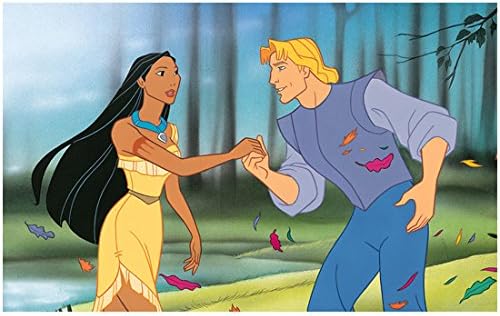
Let's start with our 2 lead characters, Pocahontas and John Smith. Creative liberties aside, the real problem is that there's really no depth to them. After the complex, yet believable relationship between Belle and The Beast, Pocahontas and John Smith are basically 2 bland goodie goods with barely any personality. There's really no arc to these characters, they just love each other regardless of different cultures and skin color.
I already addressed the comedic side characters and I really don't want to repeat myself.
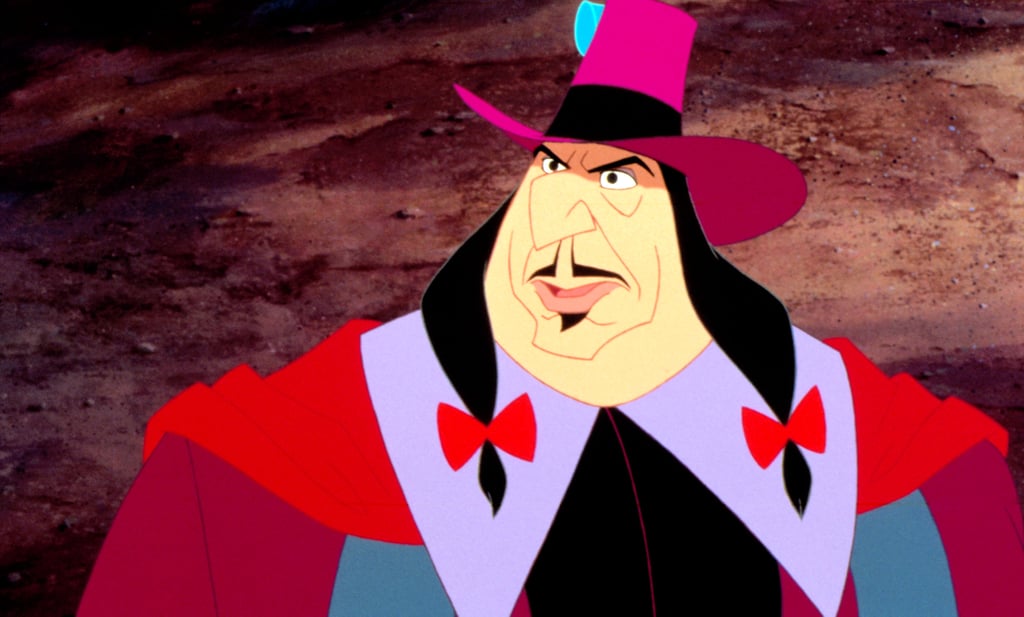
But the most disappointing character in the film is Governor Radcliffe. Roger Ebert said in his mildly positive review of the film that it lacks an interesting villain and he's right. Disney has a long history of memorable and entertaining villains. But that's really not the case with Radcliffe. He's just a one-dimensional buffoon whose primary motive is greed. That's all there is to the character.
This begs the question, if the filmmakers want to make a serious film that addresses serious subject matter, then what's the point of writing black and white characters to overly simply things for the kiddies? That's a good reason why Disney should not be making animated films based on historical events.
The Animation
The animation and art style of the film is a mixed bag. The film has some striking colors and the backgrounds and locations are well detailed. But where the animation really falters is in the characters designs.
The best place to start is the titular protagonist herself. Notice how attractive her physical appearance is. In fact, don't take my word for it. Reportedly, Jeffrey Katzenberg told Glen Keane, the character's supervising animator, that she has to look "sexy". So Keane partly took inspiration from supermodels like Naomi Campbell and Kate Moss. Kind of weird that you're assigned to animate a female character and one of the first things you do is to objectify the opposite sex. Nice job setting an example when it comes to women Disney.
But other than that, most of the character designs either come off as stiff and even comes off as uncanny valley at times. Speaking of uncanny valley...
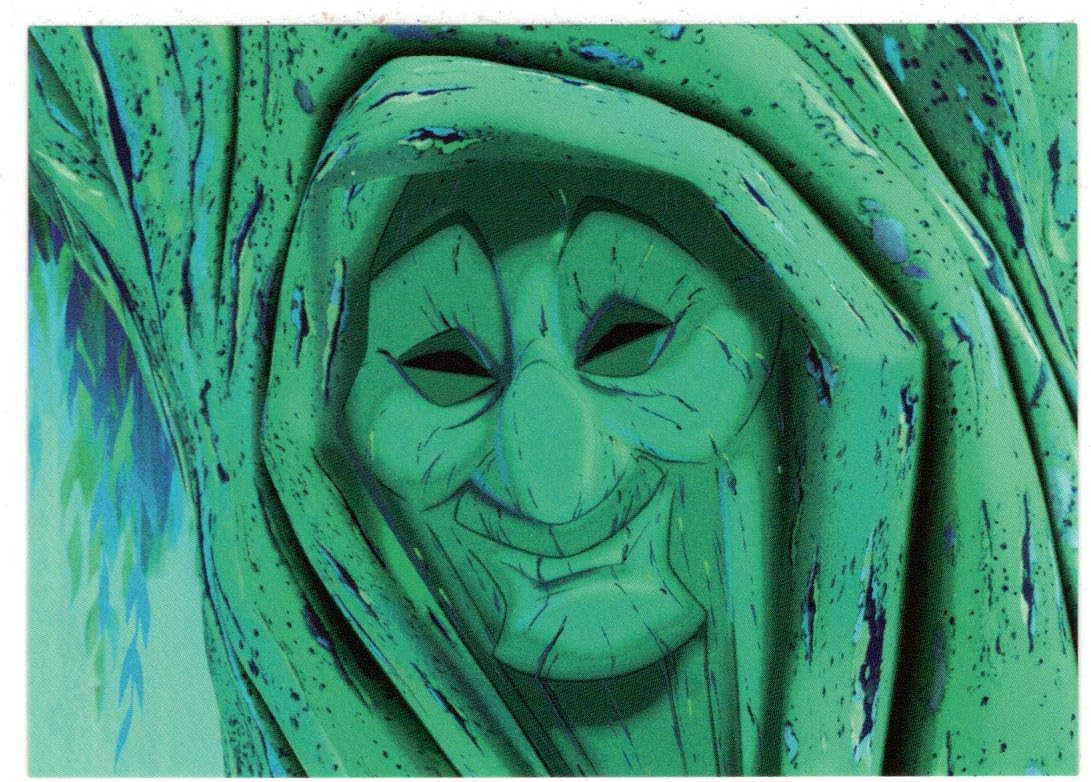
MOMMY, THERE'S A SCARY MONSTER!
Yeah, apparently Pocahontas takes words of wisdom from a talking tree named Grandmother Willow and she's scary as hell. I mean... just look at her.
The CGI work in this film doesn't really age well. After the majestic ballroom scene in Beauty and the Beast and the action packed stampede in The Lion King, the CGI looks really dated. But don't worry, because Pixar will later give us Toy Story a few months after Pocahontas and has better CG than this.
The Music
The musical score and songs were written and composed by Alan Menken, with lyrics written by Stephen Schwartz. Menken must have been struggling really hard after the death of Howard Ashman in 1991. I really like the musical score of this film, but the lyrics by Schwartz is a bit on the nose. The best example is in the villain song "Savages", when the English settlers and the Native American begin to attack (for example: "They're not like you and me, which means they must be evil"). The score is fine, but the songs are a bit on the nose.
Conclusion
Overall, Pocahontas is one of Disney's weakest animated features and the worst film in the Disney Renaissance era. I can see what the film is trying to do, but it doesn't make up for it's one dimensional characters, historical inaccuracies, beautiful looking yet stiff animation, on the nose songs, confused tone, and formulaic storyline. But the film's biggest crime is that it's nothing more than exploitative Oscar bait. Making a film to chase the Best Picture Oscar that Beauty and the Beast failed to win makes this film pretentious in my book. However, Pocahontas may very well be the only live action remake that I do want to see. Don't remake stuff like Beauty and the Beast and The Lion King, remake films like Pocahontas. That would totally make up for many of the film's flaws. If the remake gets made, I'll be ready.
In June 1995, Pocahontas was released to the big screen, during the era of The Disney Renaissance. After high hopes generated from The Little Mermaid, Beauty and the Beast, Aladdin, and The Lion King, the film finally premiered to mixed reviews from critics, harsh criticism from historians and Native American activists, and underwhelming box office scores. It was successful at the box office, but it didn't make as much money as The Lion King did the previous year. Today, while the film has it's fans, some consider it to be one of the weakest Disney animated features. So where did the disappointment really come from? Let's find out in this 2 part saga about the making of the film and how the problems resulted.
The Real Pocahontas
Before I talk about the movie, here's a brief summary about the real Pocahontas. Pocahontas was born sometime in the mid 1590's and is the daughter of her tribe's chief' Powhatan. In 1607, the English arrived in Virginia, where she lives, and settled in what is now called Jamestown, and that's pretty much the only thing the film got right. Because it's an animated film for "the whole family", Disney spares no expense into lying to little kids with its artistic license. The real Pocahontas, which was actually her nickname meaning "little brat" or "playful one", was actually about 12 or 13 when she encountered John Smith and they obviously didn't fall in love because that would make the real Smith a pedophile. She also didn't take words of wisdom from a talking tree that doesn't even exist, nor does she have a pet racoon who fights with a spoiled dog over food. And contrary to the film's happy ending, her real life ending didn't end on a high note. The real Pocahontas traveled to England, converted to Christianity, married English colonialist, John Rolfe, and died in 1617 in her early 20's. I'll address more of its historical inaccuracies in part 2, but so far, nice job lying to kids Disney.
Origins, Development, and Disney's Lust for Oscars
The origins of the film dates back shortly after The Rescuers Down Under hit theaters in late 1990. During a pitch meeting for future projects, director Mike Gabriel drew a poster of Tiger Lily from Peter Pan and wrote "Walt Disney's Pocahontas" on the top and pitched the idea in the back of the poster that reads "an Indian princess who is torn between her father's wishes to destroy the English settlers and her wishes to help them - a girl caught between her father and her people, and her love for the enemy." Meanwhile, Disney executive Peter Schneider was developing an animated version of Romeo and Juliet and when he noticed the similarities between his idea and Gabriel pitch, the project was quickly green lit.
In 1991, Beauty and the Beast opened to glowing reviews from critics, made so much money at the box office, and became the first animated film to be nominated for Best Picture. But when the Oscar ceremony took place in March 1992, Beauty and the Beast lost to The Silence of the Lambs. But no worries, because when Pocahontas was put into production, Disney's then chairman and head of the film division, Jeffery Katzenberg, had so much high hopes for this film, that he hoped that it would be the first animated film to win an Oscar for Best Picture. The studio's top animators choose to work on Pocahontas because they feel that it would be more prestigious, commercially viable, and more mainstream than the "B" film that was in production at the same time. Yeah, what was that "B" film?
Whoops!
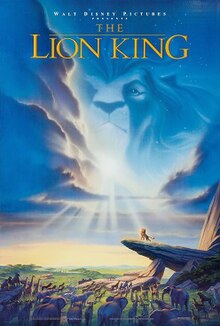
Yes, apparently, Disney viewed The Lion King as just an experiment and they really weren't sure that people are going to see the film. Probably to test the waters, The Lion King opened first in June 1994. Little did they know that The Lion King has turned out to be one of the most critically and commercially successful animated films of all time, creating a cultural phenomenon despite allegations of plagiarism of the Japanese anime series Kimba The White Lion and an infamous, controversial negative review of the film on YouTube. But those are stories for another time. Sadly, The Lion King also marked the end of Jeffery Katzenberg's tenure at Disney, as he clashed with CEO Michael Eisner over the president's job after a helicopter crash killed Disney executive Frank Wells in April 1994. Frustrated with Eisner, Katzenberg left Disney in the fall of 1994 and co founded DreamWorks along with Steven Spielberg and music producer David Geffen.
Release, High Expectations, and Disappointment
Following The Lion King's marketing strategy, Disney began to hype the movie by using the "Colors of the Wind" sequence as the film's teaser trailer. This tactic was so clever that the teaser even appeared on the original video version of The Lion King. Expectations and hype has just gotten bigger.
On June 10, 1995, the film premiered at Central Park in New York City, with 100,000 people attending the screening. The film also had tie ins from Burger King, Nestle, dolls from Mattel, and even video games for the Sega Genesis and Super Nintendo. When the film finally opened nationwide 13 days later, it opened with mixed reviews. There was praise for the animation and songs, but they expressed disappointment with it's story and characters. Even Roger Ebert, who gave it 3 stars out of 4, didn't even like the film's villain.
There was also criticism from historians and Native American groups for Disney's interpretation of history. As far as the box office returns goes, it was successful, but it made less than The Lion King, grossing $141 million domestically while The Lion King made over $1 billion worldwide. Despite the film's shortcomings, it won 2 Oscars for Best Original Song and Best Original Score.
Stay tuned for part 2, where I convey my thoughts on the film.


.jpg/250px-Paramount_Pictures_logo_(2010).jpg)


.svg/220px-Industrial_Light_%26_Magic_(logo).svg.png)


_poster.jpg/220px-Teenage_Mutant_Ninja_Turtles_(1990_film)_poster.jpg)